

A Father’s Devastating Diagnosis And Financial Struggle
When Zhang Lei was just two months old, her parents received devastating news that would forever change their lives. The tiny infant was diagnosed with congenital anemia, a terminal condition requiring constant medical intervention to keep her alive. For Zhang Liyong, a 24-year-old worker from Jiuzu Yan village in Sichuan province, this diagnosis marked the beginning of an impossible financial battle against time.
Every month since the diagnosis, little Lei requires blood transfusions at the hospital just to survive. The family has exhausted every resource available to them, spending over 140,000 yuan on medical treatments while Liyong’s monthly salary remains a modest 2,500 yuan. The stark mathematics of their situation reveals a crushing reality: the family has spent the equivalent of nearly five years of income on medical care, yet Lei’s condition continues to deteriorate.
Despite their desperate efforts and financial sacrifice, the family can no longer afford to continue the intensive treatment their daughter needs. Liyong’s worker wages prove insufficient against the relentless medical expenses, leaving them watching helplessly as their daughter’s health declines. The weight of this impossible choice—between financial survival and their child’s life—has pushed this young father toward unthinkable decisions that would soon capture the attention of millions worldwide.

The Heartbreaking Decision To Prepare For Death
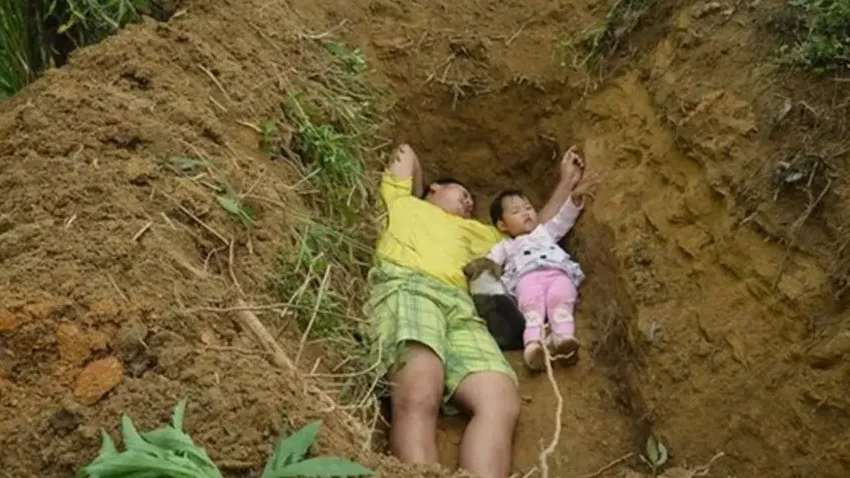
Faced with this impossible reality, Zhang Liyong made a decision that would shock the world: on June 23rd, he began digging a grave for his two-year-old daughter with his own hands. His reasoning, while heartbreaking, reflected a father’s desperate attempt to shield his child from additional suffering. According to Liyong, the purpose was to help little Lei gradually adapt to the cold, underground life so that when the inevitable moment arrived, she wouldn’t be overwhelmed by the sudden transition.
Lei’s daily existence has become increasingly isolated due to her weakened immune system and frequent illnesses. The other children in Jiuzu Yan village no longer play with her, leaving the little girl to find companionship elsewhere. She spends her days talking to the family’s ducks, playing with their puppy, or amusing herself alone in the yard. During his free time, Liyong takes his daughter fishing or on small outings, creating precious moments together while they still can.
These simple activities have become their sanctuary—a father and daughter finding joy in ordinary moments while confronting an extraordinary tragedy. Yet even as Liyong prepared for the worst outcome, he continued searching for alternatives. The image of him lying beside Lei in the freshly dug grave would soon spread across Chinese social media, but behind this devastating scene lay a family still clinging to one final hope that medical science might offer a miracle.

A Family’s Last Hope Through Stem Cell Treatment
That hope materialized when doctors at the hospital suggested a potential lifeline: stem cell treatment could still save little Zhang Lei’s life. According to medical staff, if compatible stem cells could be found and transplanted, there remained a genuine possibility of curing her congenital anemia. The treatment represented cutting-edge medical intervention that could replace her damaged bone marrow with healthy cells capable of producing normal blood.
However, this ray of hope came with devastating complications. Neither Zhang Liyong nor his wife Deng Min proved to be compatible stem cell donors for their daughter. Faced with this biological reality, the couple made an extraordinary decision that would test the limits of parental sacrifice: they chose to conceive another child, gambling that their second baby might provide the compatible stem cells needed to save Lei’s life.
Deng Min was expected to give birth on July 7th, adding urgency to an already desperate timeline. Yet even if their newborn proved to be a perfect match, the family confronted another insurmountable obstacle. The cost for preserving and transplanting the stem cells would require 12,000 yuan—approximately 40 million Vietnamese dong—while the Zhang family had already exhausted every financial resource in their previous treatment efforts.
The cruel irony was inescapable: medical science offered a cure, but economic reality made it unreachable. As Liyong continued preparing his daughter’s grave, this painful contradiction between hope and helplessness would soon capture the attention of an entire nation.

Viral Story Sparks Global Compassion And Support
That national attention arrived swiftly and powerfully. The image of Zhang Liyong lying in the freshly dug grave alongside his two-year-old daughter became one of the most viral photographs on Chinese social media platforms. The haunting visual—a father embracing his terminally ill child in the earth that would soon become her final resting place—struck an immediate chord with millions of viewers across the country.
Within hours, the Zhang family’s story spread exponentially across Chinese social networks. The compelling narrative of paternal love, medical desperation, and financial impossibility resonated deeply with online communities who recognized the universal fears embedded in this particular tragedy. Users shared the story widely, accompanied by emotional testimonials about their own relationships with family members.
The response was both immediate and overwhelming. Countless netizens across China began calling for financial support to help cover little Zhang Lei’s treatment costs, transforming individual sympathy into collective action. The 12,000 yuan needed for stem cell treatment suddenly seemed achievable through crowdfunded contributions from thousands of strangers moved by the family’s plight.
Many users admitted the story had moved them to tears, describing how the father-daughter bond captured in that grave had forced them to confront their own mortality and family relationships. Comments poured in from people expressing renewed appreciation for their own fathers and children, acknowledging how the Zhang family’s tragedy had reminded them of love’s fragility and preciousness.
The viral phenomenon demonstrated social media’s remarkable power to transform private suffering into shared human experience, mobilizing compassion across geographical and economic boundaries.
Continue Reading →